
Transform Your Smile with Invisalign at Beautiful Smiles Ontario
Invisalign is a form of clear aligner therapy that moves teeth using a series of custom, removable plastic trays, offering a discreet alternative to traditional braces while restoring oral function and smile aesthetics. This article explains how Invisalign works, who is a good candidate, the local cost landscape in Ontario, California, and practical steps to start treatment with an experienced provider. Many adult patients seek invisible teeth straightening options to improve appearance, simplify oral hygiene, and coordinate orthodontics with restorative care; this guide addresses those needs with practical examples and local context. You will learn about typical price ranges, the clinical mechanics behind aligners (attachments, IPR, and staging), financing options, and realistic timelines so you can evaluate Invisalign against other orthodontic treatment options. The article then walks through the treatment process step-by-step, outlines candidacy criteria with condition-specific guidance, compares aligners to braces, and shows how to find qualified local care in Ontario, CA. Keywords covered include invisalign dentist, dentist ontario, Invisalign cost Ontario, clear aligner therapy Ontario, and invisalign consultation Ontario to help you find and plan treatment.
Ready for a Straighter Smile?
Schedule your personalized Invisalign consultation today and discover your path to a confident smile!
How Much Does Invisalign Cost in Ontario, California?
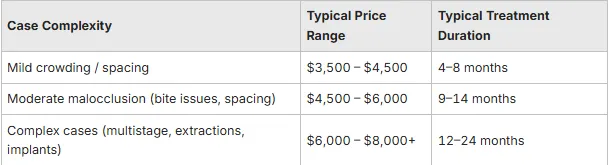
Invisalign pricing in Ontario typically reflects case complexity, treatment duration, and any adjunct procedures required to achieve stable, esthetic results. The local 2025 range for Invisalign commonly falls between $3,500 and $8,000, with milder cases at the low end and comprehensive full-treatment plans at the high end, depending on refinements and retention. Understanding the main cost drivers helps patients set realistic budgets and compare estimates from different providers. Below we break down common scenarios and provide example ranges and timelines so you can self-assess where your case may fall.
This table presents common case complexities with typical price ranges and expected durations to guide planning and budgeting.
What Factors Influence Invisalign Pricing in Ontario?
Several predictable factors determine the final Invisalign fee: the severity of tooth movement, the need for extractions or implants, the number of refinement stages, and the clinician’s use of digital technology and monitoring tools. A simple case with limited tooth movement and no adjunctive procedures will require fewer aligner sets and fewer check-ups, lowering cost and shortening duration. Conversely, cases needing interproximal reduction (IPR), attachments, or coordination with oral surgery or implant placement will increase provider time and material costs. Understanding these factors helps patients ask targeted questions during the initial consultation and compare like-for-like treatment plans.
Case severity: more tooth movement requires more aligners and visits.
Adjunctive procedures: extractions, implants, or oral surgery add to total cost.
Refinements and retention: additional aligners or custom retainers affect price.
These factors lead directly into payment planning and insurance considerations, which help many patients manage out-of-pocket expenses for aligner therapy.
Are There Payment Plans and Insurance Options for Invisalign?
Many practices in Ontario offer in-office financing or partner with third-party lenders to spread costs across monthly payments, and some patients use flexible payment platforms to match their budgetary needs. Dental insurance commonly provides limited orthodontic benefits that may contribute a portion of the fee—typical plan behavior is partial reimbursement with lifetime maximums, so patients should verify their specific caps and age eligibility. To maximize coverage, obtain a pre-treatment estimate and submit it to your insurer; ask the clinic whether they can file claims on your behalf and whether they offer sliding-scale or promotional financing.
Check typical insurance orthodontic contributions and lifetime maximums.
Ask about in-office monthly plans and third-party financing terms.
Request a written payment schedule and pre-treatment estimate before starting.
Clear financial planning reduces stress during treatment and ensures that adjunctive procedures or refinements do not become unexpected expenses, moving the conversation next to the primary clinical benefits of clear aligners.
What Are the Key Benefits of Invisalign Clear Aligners?
Invisalign offers a combination of discreet aesthetics, removable trays for improved oral hygiene, patient comfort through soft SmartTrack material, and predictable digital treatment planning that maps movements in advance. These mechanisms translate into real-world outcomes: patients often report greater confidence, simpler hygiene routines, and the ability to maintain professional appearance during treatment. Recent clinical summaries and practice experience show aligners can match braces for many adult cases when worn as prescribed, particularly for mild-to-moderate crowding and spacing. Below is a mechanism-focused table linking each major benefit to how it works and the expected patient outcome.
How Does Invisalign Compare to Traditional Braces?
Invisalign and traditional braces both move teeth effectively, but differ in appearance, hygiene impact, comfort, and certain case suitability constraints; aligners win on discretion and ease of cleaning, whereas braces may be preferred for severe rotations or complex skeletal corrections. The choice depends on clinical goals, patient adherence to wear-time (20–22 hours/day for aligners), and the need for certain tooth movements that are more predictable with fixed appliances. For adults balancing aesthetics and functionality, aligners often provide an optimal compromise, while adolescents or severe skeletal problems may still benefit from braces or combined surgical approaches.
Appearance: clear aligners are less noticeable than metal brackets.
Hygiene: removable trays allow normal brushing and flossing.
Case suitability: braces retain advantages for certain complex mechanics.
Understanding these trade-offs leads into why many adults in the Ontario area choose aligners for cosmetic and practical reasons, especially when coordination with restorative dentistry is required.
Why Choose Invisalign for Adult Teeth Straightening in Ontario?
Adults select Invisalign for its low-profile look, removable eating and cleaning convenience, and the ability to integrate orthodontic movement with restorative care—such as planning around implants or crowns—without prolonged aesthetic compromise. For working professionals and social adults, the discreet nature of aligners minimizes interruptions to daily life, while digital planning allows predictable staging when coordinating with oral surgery or dental implant timelines. The requirement for consistent wear emphasizes patient responsibility, but when adhered to, aligners deliver efficient, patient-centered outcomes that support both appearance and oral health.
Aligners facilitate coordination with restorative procedures like implants.
Discreet, removable trays support professional and social lifestyles.
Digital simulations enable predictable esthetic planning before treatment starts.
Who Is a Good Candidate for Invisalign Treatment?
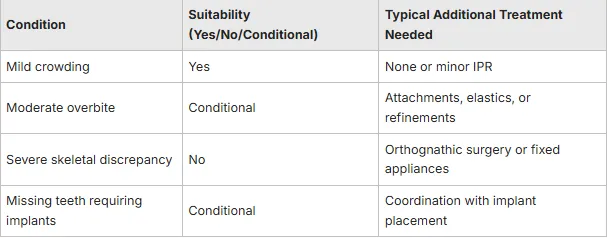
Invisalign is well-suited for adults and adolescents with mild to moderate crowding, spacing, and many bite irregularities; candidacy depends on complexity, patient commitment to wear-time, and whether adjunctive therapies are required. The system uses staged tooth movement with attachments and IPR to deliver controlled forces, but some skeletal discrepancies, severe rotations, or very large occlusal corrections may need braces or surgical intervention. Below is a condition-by-suitability table to help clarify common presentations and whether Invisalign is typically recommended, conditional, or not appropriate without adjunctive care. This table helps patients and clinicians discuss realistic expectations during the initial consult, including when to plan for combined care pathways that involve oral surgery or implant dentistry. The next subsections describe how aligners effect movement and when complexity changes the plan.
How Does Invisalign Correct Crowded Teeth, Overbites, and Other Misalignments?
Invisalign corrects malocclusions through digital treatment planning that sequences small, controlled movements delivered by successive aligner trays; attachments provide grip for complex movements and IPR creates space when needed. The aligner encourages bodily tooth movement by applying force vectors predicted in the digital plan, and attachments act as leverage points to achieve rotations or extrusions. For bite issues, elastics or precision cuts may be prescribed to influence jaw relationships, and periodic refinements allow clinicians to address under-corrections. Patients should understand that success hinges on adherence to wear schedules and attending progress checks to allow adjustments when the plan requires refinement.
Staged movements: each tray advances teeth slightly toward the final position.
Attachments: composite bumps on teeth help aligners apply targeted forces.
IPR: selective enamel reduction that creates space for alignment.
These mechanical principles clarify when aligners are highly effective and when adjunctive methods will be needed to reach stable occlusion.
Can Invisalign Treat Complex Orthodontic Issues?
Complex cases can sometimes be managed with Invisalign when combined with targeted adjuncts—attachments, IPR, temporary anchorage devices, or coordination with oral surgery—but some presentations still require fixed appliances or surgical correction for predictable results. Careful diagnosis and treatment planning determine whether a case is best handled with aligners alone or as part of a multidisciplinary approach that includes oral surgery or implants. Referral to or collaboration with specialists may expedite outcomes and protect long-term oral health when skeletal or advanced vertical discrepancies are present. Patients facing complex scenarios should expect a detailed discussion of combined pathways and realistic timelines during the consult.
Complex rotations, severe bite problems, or skeletal issues often need combined care.
Oral surgery or implant planning can be integrated into an aligner-driven timeline.
Providers will outline staged treatment and expected checkpoints before starting.
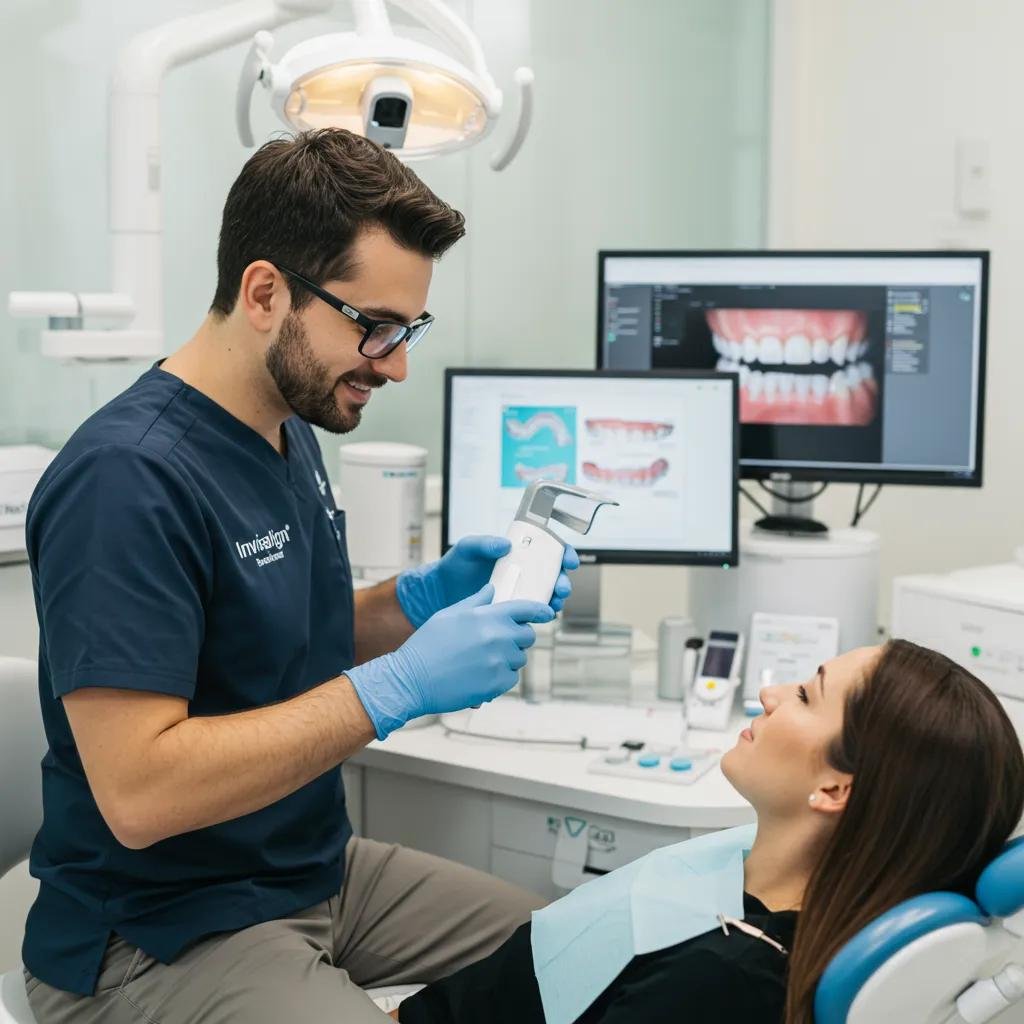
What Is the Invisalign Treatment Process at Beautiful Smiles Ontario?
The Invisalign workflow at an experienced clinic begins with an initial diagnostic visit, followed by digital scanning, virtual treatment planning, aligner fabrication, staged delivery, progress monitoring, refinements as needed, and long-term retention. During the initial phase the clinician evaluates dental and skeletal relationships, takes photographs and 3D scans, and discusses aesthetic goals and timing; the digital plan visualizes predicted tooth movements and appointment cadence. Treatment monitoring uses scheduled checks to confirm progress and implement any necessary refinements, and retention plans preserve results once active movement is complete. Same-day scanning and prompt scheduling streamline the patient journey in practices that combine technology with efficient care.
How Does the Initial Invisalign Consultation Work?
During the initial consultation the clinician conducts a comprehensive clinical exam, captures intraoral 3D scans and photographs, evaluates radiographs if needed, and discusses patient goals and constraints; this information feeds the digital treatment simulation. The clinician then reviews the ClinCheck plan or equivalent visual treatment preview with expected timeline, number of aligner sets, and any likely adjunctive steps such as IPR or attachments. Patients receive a tailored cost estimate and financing options during this visit, and the team outlines required appointments and home-care responsibilities to ensure adherence. Bringing prior dental records and a clear list of cosmetic priorities helps the clinician design a precise, efficient plan that aligns with both oral health needs and aesthetic goals.
This initial diagnostic clarity reduces surprises later and sets expectations for the treatment cadence and responsibilities needed to achieve the planned result.
What Should Patients Expect During Invisalign Treatment?
Patients should expect a predictable cadence of aligner changes—commonly every one to two weeks—paired with periodic in-office progress checks typically every 6–10 weeks, depending on case complexity and monitoring preferences. Early adjustments may produce temporary soreness or pressure for a few days after insertions; this is a normal physiologic response as teeth reposition, and over-the-counter analgesics and softer diets during adaptation often help. Hygiene remains straightforward because aligners are removable for brushing and flossing, but patients must clean trays regularly and avoid staining foods to preserve clarity. After active movement, retention with removable or fixed retainers is essential to maintain achieved alignment, and occasional follow-ups confirm long-term stability.
These expectations emphasize patient participation—consistent wear and care are crucial to achieving the projected treatment outcome and minimizing the need for extensive refinements.
Ready to Start Your Invisalign Journey?
Our team is here to guide you through every step of the process, from consultation to your new smile.
Achieve a Perfect Smile with Invisalign's Clear Aligners
Finding a qualified Invisalign provider locally involves evaluating clinician experience with aligner therapy, the clinic’s use of digital diagnostics and monitoring, patient testimonials, and the ability to coordinate orthodontic care with restorative or surgical services when necessary. Look for providers who demonstrate transparent pricing, sample treatment plans, and clear timelines; technology such as intraoral 3D scanning and digital simulations typically improves predictability and patient understanding. For Ontario-area patients seeking a local option, many practices highlight awards, advanced workflows, and multidisciplinary capabilities that support complex restorative cases.

Why Choose Beautiful Smiles Ontario for Your Invisalign Treatment?
At Beautiful Smiles Ontario, we are dedicated to helping patients restore oral health and confidence through expert oral surgery and dental implant services, while delivering compassionate, high-quality dental care to the Ontario community. We combine advanced technology with a patient-centered approach to ensure predictable and satisfying Invisalign outcomes.
Beautiful Smiles Ontario is a local dental clinic serving Ontario, CA and nearby communities with a focus on cosmetic dentistry, Invisalign clear aligners, and coordinated restorative care. The practice lists awards and recognitions and offers same-day services and technology-driven workflows to support efficient treatment planning. When comparing providers, verify specific Invisalign experience, ask for sample case timelines, and confirm how the practice manages combined care pathways like implants or extractions.
What Makes Dr. Hosny a Leading Invisalign Provider in Ontario?
Dr. Hosny is the named clinician associated with Beautiful Smiles Ontario and is presented as a specialist in cosmetic dentistry and Invisalign treatment with recognitions noted in local listings; these factual highlights indicate a clinic-level focus on esthetic and restorative outcomes. The practice references awards and local trust signals that prospective patients can consider when choosing a provider, and clinician experience typically translates into more accurate treatment planning, fewer surprises, and efficient management of adjunctive procedures. Patients should ask during consults about specific case examples and whether the clinician manages implant or oral surgery coordination directly or through specialist referrals.
These provider-focused questions help you verify that the clinician’s practical experience matches your case complexity and aesthetic goals.
How Does Beautiful Smiles Ontario Combine Technology and Care for Invisalign?
Beautiful Smiles Ontario integrates digital tools such as intraoral scanning and digital treatment simulations with a patient-centered service model that emphasizes comfort, transparency, and coordinated restorative planning. Technology reduces chair time for records collection and produces visual previews that help patients understand expected outcomes and appointment timing. A care model that pairs modern equipment with in-office support—same-day scanning, clear financial options, and coordinated referrals for oral surgery or implants—improves predictability and patient satisfaction. Asking about the clinic’s monitoring cadence and how they handle refinements will clarify whether their workflow matches your expectations for responsiveness during treatment.
These workflow considerations prepare patients to compare local providers on both technical capabilities and the quality of patient experience.
Frequently Asked Questions
The duration of Invisalign treatment varies based on individual needs, but most patients can expect to wear aligners for about 12 to 18 months. Mild cases may take as little as 6 months, while more complex situations could extend treatment to 24 months or longer. Regular check-ups every 6 to 10 weeks help ensure progress is on track, and adjustments can be made as needed. Adhering to the recommended wear time of 20 to 22 hours per day is crucial for achieving the desired results within the estimated timeframe.
One of the advantages of Invisalign is that the aligners are removable, allowing patients to eat and drink without restrictions. However, it is recommended to remove the aligners when consuming anything other than water to prevent staining and damage. After eating, patients should brush their teeth before reinserting the aligners to maintain oral hygiene and prevent plaque buildup. This flexibility makes it easier to maintain a normal diet compared to traditional braces, which can limit food choices.
If you lose or break an aligner, it’s important to contact your orthodontist as soon as possible. Depending on how far along you are in your treatment, your orthodontist may recommend that you switch to the next set of aligners or provide a replacement for the lost or damaged one. Continuing to wear the previous aligner for a short period may also be suggested until a replacement is available. Prompt communication ensures that your treatment timeline remains on track.
Invisalign is effective for many mild to moderate orthodontic issues, but severe cases may require traditional braces or a combination of treatments. Complex conditions, such as significant skeletal discrepancies or severe rotations, often necessitate additional interventions like oral surgery or fixed appliances. A thorough evaluation by an experienced provider will determine the best treatment plan tailored to your specific needs, ensuring optimal results and oral health.
To keep your Invisalign aligners clean and clear, it’s essential to follow a proper hygiene routine. Rinse the aligners with lukewarm water each time you remove them, and gently brush them with a soft toothbrush to remove plaque and bacteria. Avoid using toothpaste, as it can scratch the aligners. Additionally, soak the aligners in a cleaning solution recommended by your orthodontist to maintain their clarity and prevent odors. Regular cleaning helps ensure a comfortable fit and effective treatment.
While some discomfort is common during the initial days of wearing a new aligner, it is generally mild and manageable. Patients may experience pressure or soreness as the aligners shift teeth into their desired positions. This sensation typically subsides within a few days. Over-the-counter pain relievers can help alleviate any discomfort. Unlike traditional braces, which can cause more significant irritation to the gums and cheeks, Invisalign’s smooth plastic design minimizes discomfort during treatment.
To achieve the best results with Invisalign, it’s crucial to wear your aligners for the recommended 20 to 22 hours a day and change them according to your orthodontist’s schedule. Attend all scheduled check-ups to monitor progress and make necessary adjustments. Maintain good oral hygiene by brushing and flossing regularly, and clean your aligners as instructed. Staying committed to your treatment plan and following your provider’s recommendations will help ensure a successful outcome and a beautifully aligned smile.